A Sky Map or a Familiar Star? Finding Your First Constellation
Choose a sky map or a familiar star to find your first constellation, with clear ways to match a chart to the visible sky and avoid common mix-ups.
The common mistake when finding a constellation is to assume the star pattern will look like the lines printed on a chart. That can leave you searching the wrong patch of sky; a sky map or a familiar star gives you a better starting point. Use the map to understand where a pattern sits, and use a known star when you need a visible anchor.
What makes a constellation difficult to recognise?
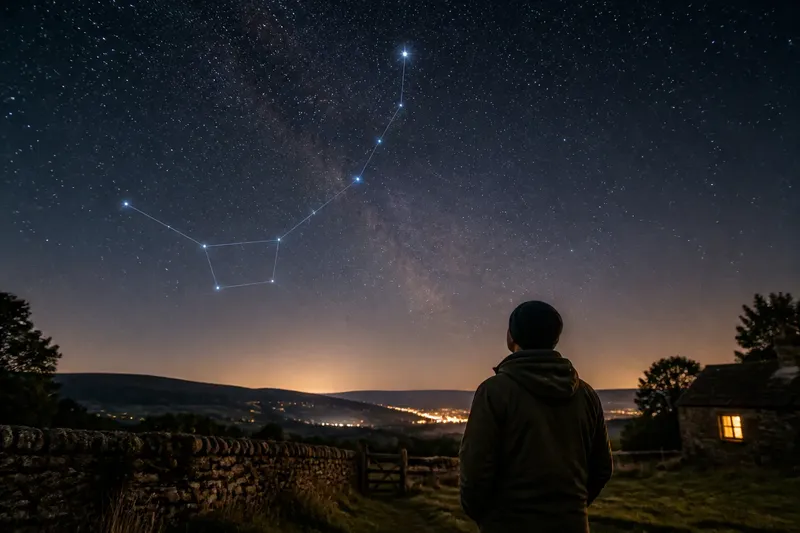
A constellation is a region of the sky, not a set of lines joining stars. Its most familiar outline is a human-made guide, and the stars within it can look quite different depending on how dark your surroundings are and which stars you can see.
Light from houses, street lamps and the Moon can hide fainter stars. Start by looking for a small, distinctive group of bright points rather than trying to account for every star on a chart. Do not treat a missing faint star as proof that you are looking in the wrong place.
Cloud, haze and trees can also obscure part of a pattern. If only a portion is visible, note the clear section and return to the rest when the view improves; forcing a complete outline from a few points can lead you to the wrong constellation.
How does a sky map help you find a constellation?
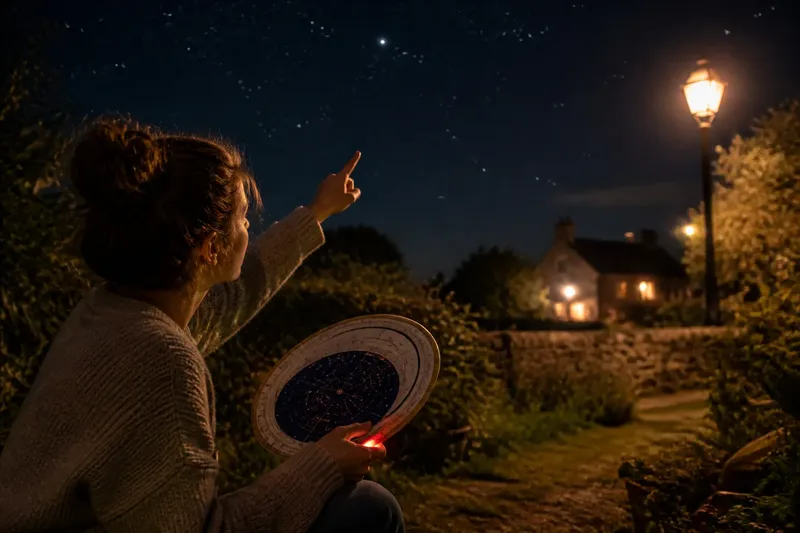
A printed sky map shows how constellations relate to the horizon and to nearby patterns. A rotating star chart, or planisphere, can be set to show which stars should be above the horizon at a chosen date and time. A fixed seasonal chart is simpler, but check its caption to make sure it covers the time of year you are observing.
Choose a chart with clear horizon labels and prominent star symbols. Before going outside, select one constellation and identify its brightest star or most distinctive group. A red torch can make the page readable while preserving more night vision than a bright white light, although you may still need to allow your eyes time to adjust after looking at the chart.
At the observing spot, turn your body to face the direction marked on the map. Look for the main group of stars first, then check nearby patterns and the constellation’s position above the horizon. If the map has a different orientation from what you expect, follow its direction labels rather than rotating the page at random.
When is a familiar star the better starting point?
A recognisable star gives you a place to begin without requiring you to interpret the whole chart. From it, search for a nearby group or another bright star, then use a map to check the broader arrangement. This can be easier under village lights, when faint chart symbols have no visible match.
A planet can be a useful landmark for one evening, but it moves against the background stars. If you begin with a bright point that might be a planet, check it with a reliable sky map or app, and do not use it as a permanent marker for a constellation.
Say you can identify a bright star low in the southern sky but are unsure what lies around it. You check a seasonal chart for the direction you are facing and find the two brightest neighbouring stars shown near it. If their order and relative positions broadly match, use that group to identify the larger pattern; if they do not, check the chart’s time and direction before choosing another anchor.
What should you check before settling on a constellation?
How do I know the chart is set for the right time?
For a planisphere, align the date and time using the instructions printed on its rim. With a fixed chart, check its season and viewing-time notes; if they do not fit the evening, choose a chart made for that period.
Should I expect every charted star to be visible?
No. Fainter stars may disappear in light pollution, haze or moonlight, so begin with the brightest symbols. If the main group is visible but smaller points are not, work with the clear stars rather than abandoning the match.
What if a bright point is a planet?
Compare it with a current sky app or chart that identifies planets for your date and location. If it is a planet, use it only as a temporary directional clue and confirm the constellation with the surrounding stars.
What should I do when the map and sky seem different?
Check the date, time, direction and horizon before changing your identification. If these are correct, allow for missing faint stars and compare the main bright group; if that group still does not fit, try a neighbouring pattern instead of forcing the outline.
How can you decide which method to use?
Use these checks to choose a starting method and decide what to do next:
- Check whether you already recognise a bright star. If you do, start there and use a chart to confirm nearby patterns; if not, select a simple sky map and begin with its boldest group.
- Check whether the chart names your observing season and time. If it does, use it as printed; if it does not, switch to a suitable seasonal chart or a settable planisphere.
- Check whether the main stars on the map are visible overhead. If they are, compare their positions; if only faint stars are missing, focus on the bright group, but if the main group is absent, recheck your direction.
- Check whether you can read the map without a bright screen or torch. If you can, keep using it briefly; if not, dim the phone or use a red torch, then look back at the sky.
- Check whether the candidate anchor could be a planet. If an app or current chart identifies it as one, treat it as temporary and verify the star pattern; if it is a star, use it as a steadier reference.
- Check whether cloud or a tree blocks part of the constellation. If the main group remains clear, identify that section and wait to check the rest; if the group itself is obscured, choose a visible target elsewhere.
Imagine you are at a village garden and can recognise one bright star, while a nearby street lamp washes out the fainter points. You check a planisphere set for the evening and direction, then compare the star with the two brightest neighbouring symbols. The first neighbour appears in the expected position, but the second is hidden by the lamp: you use the visible pair as a tentative match, move to a darker part of the garden to check the broader group, and revise your choice only if the additional stars disagree.
What is not worth the effort?
There is little value in memorising a long list of star names or buying a detailed atlas before you can recognise a few bright groups. A simple seasonal chart, a dim torch and one visible anchor are enough to practise matching the sky around you. For a first constellation, choose a map when you need context and a familiar star when you need a quick starting point.