Why the Moon Keeps Changing Its Shape
Why the Moon keeps changing its shape comes down to sunlight and viewpoint; learn what each phase means and how to identify it outdoors.
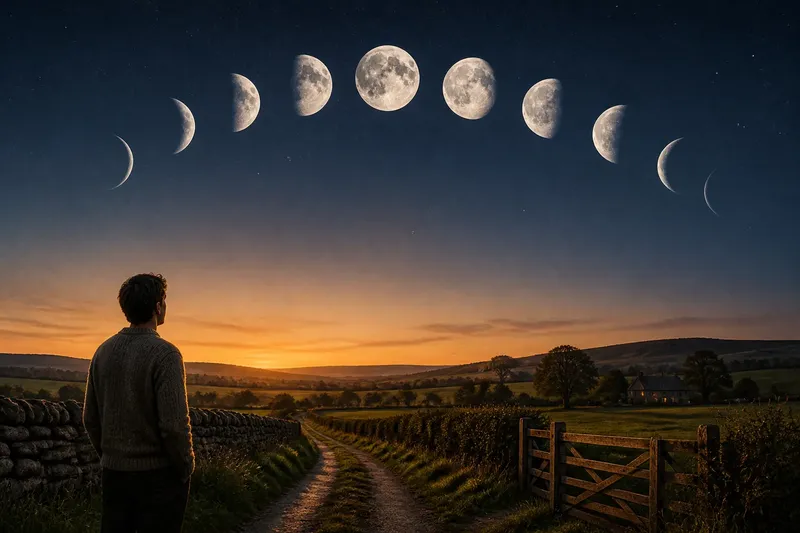
The common mistake is to think Earth’s shadow is continually covering the Moon. That explanation fits a lunar eclipse, but ordinary phases have a different cause: the Moon’s shape stays nearly spherical while sunlight illuminates half of it, and we see changing amounts of that sunlit half as the Moon travels around Earth. Understanding that geometry makes the crescent, half-moon and full Moon easier to recognise—and explains why the same phase can look different in the sky.
What changes: the Moon or your view?
Sunlight always reaches one half of the Moon, except during a lunar eclipse. The boundary between its illuminated and dark sides is called the terminator. It is not a solid line on the Moon; from Earth, it marks where sunlight gives way to night.
As the Moon orbits Earth, the angle between the Sun, Moon and observer changes. We see different portions of the Moon’s daylight half, so the visible bright shape grows from a thin crescent to a full disc, then shrinks again. The Moon itself does not turn into a crescent or lose pieces.
Imagine standing outside as a ball is lit by a lamp across a darkened room. Walk around the ball, and the lit area you can see changes even though the lamp still illuminates half of it. The Moon’s setting is vastly larger, but the changing viewpoint is the same basic idea.
Which phase fits what you see?
Phases follow a repeating order. The names describe how much of the visible disc is illuminated and whether that lit area is increasing or decreasing:
- New Moon: The Moon is roughly between Earth and the Sun. Its sunlit half faces mostly away from us, leaving the disc difficult or impossible to see in ordinary twilight or darkness.
- Waxing crescent: A slim bright curve is visible after new Moon, with the illuminated portion increasing each day.
- First quarter: About half the apparent disc is lit, and the visible bright portion is growing. “Quarter” refers to the Moon’s position in its cycle, not to a quarter of the disc being lit.
- Waxing gibbous: More than half is lit, with the bright area still growing as full Moon approaches.
- Full Moon: The side facing Earth is close to fully illuminated. Earth lies roughly between the Sun and Moon, though the alignment is not usually exact.
- Waning gibbous: More than half remains lit, but the visible bright area is shrinking after full Moon.
- Last quarter: About half the disc is lit again, this time with the illuminated portion decreasing.
- Waning crescent: A narrowing curve remains before the cycle returns to new Moon.
Waxing means the visible lit portion is growing; waning means it is shrinking. A half-lit Moon can therefore be either first quarter or last quarter. Its appearance alone may not tell you which: note whether the bright area grows on the following nights.
Why does the lit edge look different from place to place?
The terminator looks curved because you are seeing the boundary on a round surface. Its changing position across the disc gives the familiar progression through the phases. The curve does not mean that Earth’s shadow is sliding over the Moon.
Orientation depends on where you stand and how you turn your head. A crescent that appears to open sideways in one view may look tilted or more upright from another location. The Moon’s position in the sky also changes over the course of an evening, so compare phase by the fraction illuminated rather than relying only on a memorised direction for the crescent’s points.
Do not expect the Moon to rise at the same time or in the same part of twilight every night. Its orbit carries it eastward against the background of the sky, so it generally appears later from one day to the next. That changing schedule is related to the phase cycle, but it is not the reason the bright portion changes.
How can you tell whether the phase is waxing?
For a straightforward outdoor check, look at the Moon on successive evenings when weather and visibility allow. If the illuminated portion expands, it is waxing; if it contracts, it is waning. A simple lunar calendar can confirm the phase name, but watching the change makes the distinction clearer.
Say you spot a half-lit Moon above a rural lane and cannot remember whether it is first or last quarter. Make a quick sketch of the bright area, then compare it with the Moon on a later clear evening. If the bright area has grown, the Moon was waxing; if it has narrowed, it was waning.
You can also use the Sun’s position as a guide. The sunlit side of the Moon faces generally towards the Sun, even when both are above the horizon. The angle between them changes through the cycle, so this is a useful check on the lighting geometry, not a rule that every crescent will point in one fixed direction.
What should you expect in these viewing situations?
Why is the Moon hard to see near new Moon?
Near new Moon, the bright side faces mostly away from Earth, while the Moon is near the Sun in the sky. It can be lost in daylight or twilight glare, and its narrow, unlit appearance may be too faint to pick out.
Why can a crescent show a faint glow on its dark side?
Sometimes the rest of the lunar disc is faintly visible even though only a crescent is directly lit by the Sun. This is earthshine: sunlight reflected from Earth reaches the Moon and then reflects back towards us. It is most noticeable when the crescent is thin and the sky is dark enough to reveal the dim glow.
Is the Moon’s shadow what creates its phases?
No. The dark part during an ordinary phase is the side turned away from the Sun, not a region covered by Earth’s shadow. Earth’s shadow crosses the Moon during a lunar eclipse, a separate event that requires a close alignment.
Why is a full Moon not eclipsed every month?
The Moon’s orbit is tilted relative to Earth’s path around the Sun, so at most full Moons the Moon passes above or below Earth’s shadow. A lunar eclipse happens only when the alignment is close enough for the shadow to fall across the Moon.
Which observation method suits your evening?
If you want to learn the phase quickly, use your unaided eyes. The changing outline is clear without equipment, and a pair of binoculars is not needed to tell a crescent from a gibbous Moon.
If the Moon is bright and you want to inspect the terminator, binoculars can make craters and the uneven boundary easier to notice. Keep the view comfortable, and avoid pointing binoculars towards the Sun. A small telescope can reveal more detail, but it is not necessary for understanding why the phase changes.
If clouds interrupt your observations, note the date and phase in a notebook or check a printed lunar calendar after the sky clears. A calendar is useful for predicting the general phase, while direct observation helps you see the orientation and the actual amount illuminated from your location.
What is not worth the effort is trying to identify every phase from the crescent’s tilt alone. Buildings, hills and your viewing direction can make that orientation look unfamiliar; the waxing-or-waning check over successive clear nights is more dependable for a beginner.
How does the geometry fit together?
The Moon reflects sunlight; it does not make its own visible light. At new Moon, the sunlit hemisphere faces mostly away from Earth. At full Moon, that hemisphere faces mostly towards us. Between those positions, we see part of the boundary between lunar day and night.
This geometry also explains why the Moon’s phase is not simply a measure of distance from Earth. The changing illumination depends on the relative positions of Sun, Earth and Moon, while the changing apparent size has a different cause. Keep those ideas separate when interpreting what you see.
For the question “why the Moon keeps changing its shape”, the useful answer is that its shape does not change: sunlight lights half of it, and its orbit changes how much of that half reaches your view. Once that distinction is clear, a thin crescent or broad bright disc becomes a visible cue to the Moon’s position in its repeating cycle.